
REVIEW · GERMANY
Dresden: Advent Tour with Stollen Tasting and Mulled Wine
Dresden’s Christmas season is best understood on foot, with a slice of Stollen in one hand and a warm cup of mulled wine in the other. This 90-minute walk links the Old Town’s grand sights with three Christmas markets and explains local customs such as Pflaumentoffel figures and Ore Mountain woodcarvings.
I like the route for two reasons: it gives you a quick look at Dresden’s grandest squares, and it connects those sights to living Saxon holiday traditions. The guide is described as friendly, funny, and ready for questions, which helps make the history useful rather than dry. The main drawback is the tasting size. You may receive only very small pieces of Stollen and a small punch, and one tasting stop has occasionally been unavailable.
Key points to know before booking
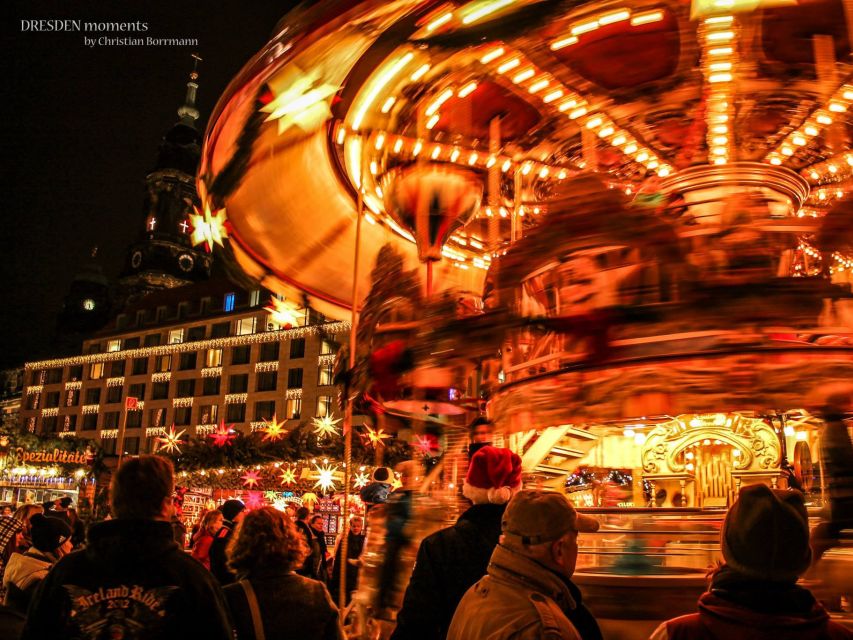
- Three Christmas markets in 90 minutes: You see several festive areas without giving up a full day of sightseeing.
- A strong Old Town route: The walk includes the Frauenkirche, Procession of Princes, Royal Palace, Semper Opera, Zwinger, and Striezelmarkt.
- Saxon customs take center stage: Learn about Dresden Stollen, Pflaumentoffel, and Ore Mountain candle arches and carvings.
- German-language guiding only: The live tour is conducted in German, so a basic understanding of German will help.
- Tastings are modest: Expect samples rather than a full snack or drink stop.
- Good for families: The short route, lights, markets, and approachable guiding suit children better than a long museum visit.
Starting beneath the Frauenkirche at Neumarkt
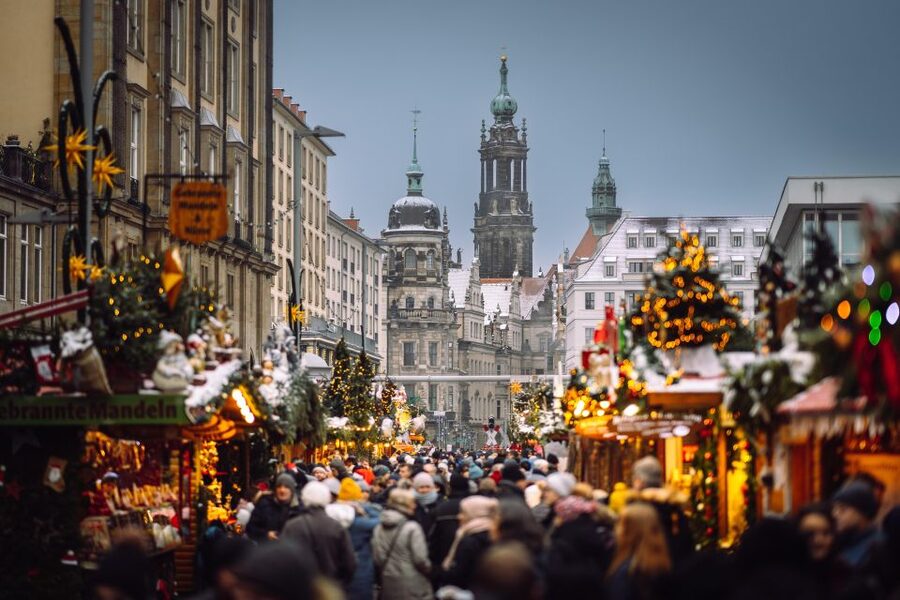
The tour begins at Neumarkt, one of Dresden’s most important squares and the setting for the Frauenkirche. You meet in the lower level of the QF Passage, in the seating area of Dresden Information. That detail matters: the meeting point is indoors, but the square above can be busy during Advent, so give yourself enough time to find the passage and go downstairs.
The Frauenkirche gives the opening a clear sense of place. Its great dome rises directly over the square, while Christmas stalls and decorations fill the area around it. Your guide uses this first stop to introduce Dresden’s holiday customs and explain why Christmas markets matter so much in Saxony.
I like beginning here because you get orientation before the shopping starts. You are not simply dropped into a row of stalls with no idea where you are. Instead, the tour sets Dresden’s religious, royal, and festive identity side by side.
The route is outdoors for much of its length. Wear shoes that handle cobblestones and bring a warm coat. December in Dresden can be cold, and you will pause at several open squares rather than remain inside.
A few more wine days around Germany worth comparing
- Trier: Guided City Walk with Wine Tasting
★ 4.8 · 979 reviews - Freiburg: Veni, vidi, vino – wine hike and tasting
★ 4.5 · 144 reviews - Reil, Mosel: Guided organic wine tasting and cellar tour
★ 4.8 · 84 reviews
Reading Dresden’s story on the Procession of Princes
From Neumarkt, the walk continues toward the Procession of Princes, a long porcelain mural showing Saxon rulers. It is one of the most memorable outdoor sights in the Old Town because you can study a large piece of art without buying an admission ticket or entering a museum.
The mural also fits the Christmas setting well. Dresden’s markets are not isolated attractions. They sit among palaces, churches, royal monuments, and grand public buildings. As you move between stalls, your guide shows how the city’s festive traditions grew within this older setting.
This stop is especially useful if you are visiting Dresden for only a short time. You see a major piece of local art while walking from one market area to another. The guide can also answer questions, and the feedback about the tour points to clear explanations as one of its strengths.
The pace should feel brisk but manageable. In 90 minutes, there is little time for long personal shopping stops. If you want to inspect every ornament, sample every pastry, or wait in a busy food line, you will need to return to the markets after the tour.
From the Royal Palace to the Semper Opera
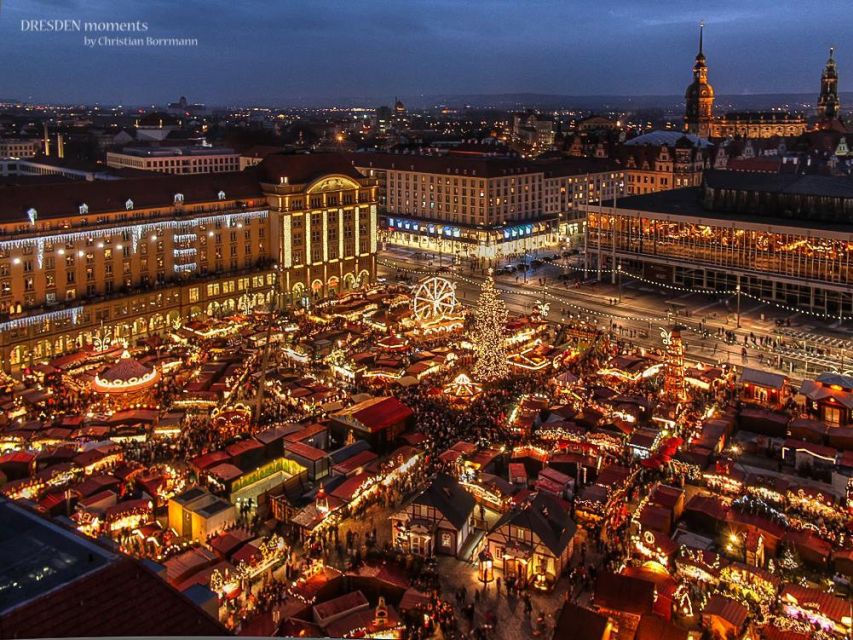
The route then passes the Royal Palace and the Semper Opera. These buildings give the walk a change of mood. The market stalls bring lights, food, and music, while the palace and opera house show Dresden’s formal side.
The Royal Palace represents the city’s courtly past. The Semper Opera adds another layer, tied to music and performance. You do not visit these interiors as part of the tour, so think of the stops as exterior sightseeing and context rather than full museum visits.
That distinction is important when you judge the price. At $18 per person, you are paying for a guided walk, local explanation, and two small tastings, not admission to Dresden’s major attractions. If you already know the Old Town well, the value rests mainly in the Christmas customs and the guide’s storytelling.
I like this part of the route because it keeps the tour from becoming a simple food crawl. The guide connects the decorated squares to Dresden itself. You learn about the buildings, then see how the Christmas season changes their surroundings.
The Zwinger and Dresden’s grandest views
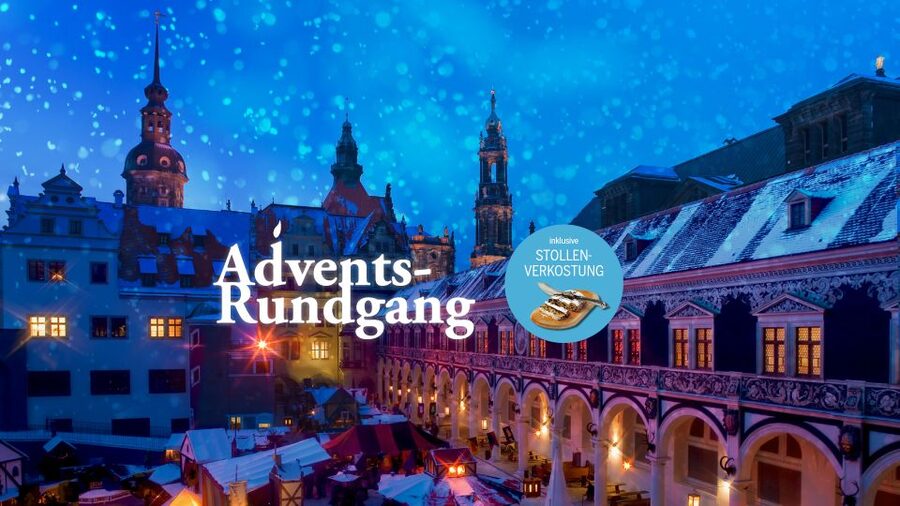
The walk continues to the Zwinger, one of Dresden’s most recognizable architectural spaces. Its broad courtyards and ornate Baroque forms provide a striking contrast to the wooden market huts and glowing decorations.
The Zwinger is a good photo stop, but you should keep your expectations clear. The tour does not include a museum visit or a long exploration of the complex. You see it as part of the Old Town walk, with the guide explaining the place before moving on.
This is one reason the tour works well early in a Dresden visit. You get a map in your head: Neumarkt, the Procession of Princes, the palace quarter, the opera, the Zwinger, and the market area. Afterward, you can return to the spots that deserve more time.
The route also gives you a chance to see Dresden’s architecture under seasonal lighting. The decorations do not replace the city’s history. They frame it, which is a more satisfying way to experience the markets than spending the whole evening among stalls without looking up.
Same region, a completely different afternoon:
- Hamburg: Harbor Cruise with Wine and Cheese
★ 4.7 · 795 reviews - Leipzig: Mulled Wine Motorboat Tour
★ 4.7 · 514 reviews - Berlin: Dinner Cruise on the Spree with Prosecco
★ 4.4 · 298 reviews - Heidelberg: Sightseeing Boat Tour with Mulled Wine
★ 3.6 · 202 reviews
Striezelmarkt and the meaning of Dresden Stollen
The final market stop is the Striezelmarkt, Dresden’s best-known Christmas market. The name is linked to Strüzel or Stollen, the traditional fruit bread associated with Dresden. Here, the market experience becomes more closely tied to local food and craft.
Your guide explains Dresden Stollen and gives you a tasting. This is not meant to be a full dessert course. The portions can be quite small, with some feedback describing samples about the size of a sugar cube. You may also receive a small cup of mulled wine or punch.
That modest serving is the clearest weakness of the experience. If you book mainly because you want a generous food tasting, you may feel shortchanged. The value is better if you view the samples as introductions, then buy a larger slice or cup for yourself afterward.
The Stollen itself matters because it is more than a generic Christmas cake. It is one of the foods most closely linked with Dresden’s December identity. Learning the name, the local connection, and the place to try it gives you a better reason to seek it out later.
The mulled wine adds warmth and atmosphere, but do not treat it as a full drink stop. The portion is small. You will likely want to order another cup once the tour ends if you plan to linger at the market.
Saxon traditions beyond sweets
The tour also covers Pflaumentoffel, small dried-fruit figures associated with Dresden’s Christmas season. These unusual figures help show that Saxon holiday culture is not limited to gingerbread, lights, and hot wine.
You also hear about Ore Mountain woodcarvings. The Ore Mountains are known for traditional wooden Christmas decorations, including candle arches and pyramids. The tour points out an enormous Saxon Schwibbogen, or candle holder, and the world’s largest Christmas pyramid.
These displays give the markets a strong sense of place. Many European Christmas markets sell similar foods and ornaments, but the Saxon crafts add local character. I find this part more useful than a simple list of shopping stalls because it tells you what to look for after the tour.
You might find yourself noticing carved figures, candle arches, and pyramid designs at other markets in Dresden or elsewhere in Saxony. The guide gives you the vocabulary to recognize those objects instead of seeing them as generic decorations.
What the three markets offer in a short walk
The appeal of visiting three markets is variety, but the time limit also creates a tradeoff. You see several decorated areas and get a quick sense of their different layouts. You do not have enough time to browse each one at leisure.
The market stops are most useful for first-time visitors who want a guided introduction. You can identify where to return for food, gifts, crafts, or photos later in the evening. If you already have a detailed Christmas market plan, the tour may feel more like a compact overview.
Expect plenty of enticing smells, lights, stalls, and seasonal displays. You will also encounter crowds, especially near the most popular squares. The guide’s job is to keep the group moving and explain the setting, not to provide a private shopping escort.
For families, the short duration helps. Children get the lights, sweets, wood figures, and large pyramid without being asked to endure a long historical lecture. The friendly and humorous guiding style also helps keep the walk light.
How the $18 price measures up
At $18 per person, this is a fairly modest-cost way to add structure to an evening in Dresden. The price includes the guided city walk, information about Christmas traditions, a Stollen tasting, and mulled wine.
The strongest value comes from combining several sights in one route. If you would otherwise pay for a separate orientation walk, the tour can make sense. You also avoid spending your first hour trying to work out where the main markets and Old Town landmarks are located.
The tasting is where the price may disappoint. Two very small samples and a small punch do not amount to a meal or a substantial food tour. You should budget separately for market food and drinks.
I would book this for the context, not for the quantity of food. At this price, a guided introduction to Dresden’s central sights and seasonal customs is reasonable. I would not book it if your main goal is a long, generous Stollen tasting.
Language, pace, and practical details
The live guide speaks German. This is the single most important booking consideration. If you understand conversational German, you should be able to follow the explanations and ask questions. If you do not, the experience may be difficult because no other language is listed.
The walking time is 1.5 hours, and the route stays in Dresden’s Old Town. No transport is included or needed for the described route. You should plan for outdoor walking, market crowds, and winter weather.
The meeting point is specific: go to the lower level of the QF Passage and find the seating area at Dresden Information. Do not wait outside the Frauenkirche unless the instructions you receive tell you otherwise.
The tour provider is Dresden Information. The booking terms allow free cancellation up to 24 hours before the start time, and you can reserve now and pay later. Those options are useful during a December visit, when weather and changing holiday plans can affect your schedule.
One practical caution concerns the tasting stops. A venue can be closed, and one scheduled Stollen tasting has not always taken place. If that tasting is central to your plans, keep expectations flexible and treat the food as an extra rather than the main event.
Who will enjoy this Dresden Christmas walk
I would recommend the tour most strongly to:
- First-time visitors who want a quick Old Town orientation
- People who enjoy local customs and seasonal food traditions
- Families looking for a short, festive activity
- Visitors who understand German and prefer a live local guide
- Anyone with limited time who wants several major sights in one walk
I would be more cautious if you want a detailed architectural tour, substantial food portions, or free time at every market. The route is compact and well packed. That is its strength, but also its limit.
The walk also suits a first evening in Dresden. You can learn the layout, see the major squares, taste the local specialties, and then return to the market that interests you most. I would not use it as your only Dresden sightseeing experience because the interiors of the Royal Palace, Semper Opera, and Zwinger are not part of the tour.
Should you book the Dresden Advent Tour?
Book it if you want a friendly German-language introduction to Dresden’s Christmas season, with major Old Town sights and local traditions in one short outing. The guide, route, and Saxon craft stories are the strongest reasons to go.
Skip it if you expect a full meal, large tastings, or a detailed visit inside the city’s monuments. The samples may be tiny, and a tasting stop can occasionally be unavailable.
For $18, I see this as a useful orientation walk with festive extras. Come for the Frauenkirche, Procession of Princes, palace quarter, Semper Opera, Zwinger, three markets, and Saxon Christmas stories. Treat the Stollen and mulled wine as a small bonus, then stay in the market and order more on your own.
FAQ
Where does the Dresden Advent Tour begin?
It begins in the lower level of the QF Passage, in the seating area of Dresden Information.
How long does the tour last?
The tour lasts 1.5 hours.
What language is the tour conducted in?
The live guided tour is conducted in German.
Which Dresden sights are included on the walk?
The route includes Neumarkt and the Frauenkirche, the Procession of Princes, the Royal Palace, the Semper Opera, the Zwinger, and the Striezelmarkt.
How many Christmas markets does the tour visit?
The tour visits three of Dresden’s main Christmas markets.
Are Stollen and mulled wine included?
Yes. The experience includes a tasting of Dresden Stollen and mulled wine. The portions may be small.
Can I cancel the booking?
Yes. You can cancel up to 24 hours in advance for a full refund. Reserve now and pay later is also available.
Just added around Germany
- Sylt: Shell safari with boat | incl. Mussel tasting & 1 glass of wine★ 4.7 · 49 reviews
- Stuttgart: Guided Vineyards Tour★ 4.3 · 146 reviews
- Stuttgart: Stuttgart Wine Museum Wine Tasting★ 4.7 · 55 reviews
- Heidelberg: Hills and Wine Region Segway Tour★ 4.9 · 89 reviews
- Reil, Mosel: Guided organic wine tasting and cellar tour★ 4.8 · 84 reviews
- Mulled wine ride in the Leipzig New Zealand★ 4.3 · 43 reviews
- Lieser: Covered wagon ride, the rolling wine tasting with picnic basket★ 4.7 · 51 reviews
- Kröv, Mosel: Covered wagon ride through the vineyards with wine tasting★ 4.8 · 46 reviews
Wine Tours in Germany, compared.

Heidelberg: Sightseeing Boat Tour with Mulled Wine
Read our review →
Freiburg: Veni, vidi, vino – wine hike and tasting
Read our review →
Browse the lists this tour appears in